Zingiber officinale |
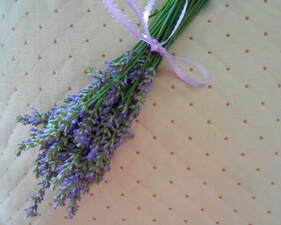
| One of the simplest ways to use lavender is to simply gather the stalks of lavender and tie with a ribbon. It's best to cut them as soon as the flowers are in bloom in the spring. Cut them a few inches above the woody growth so you won't harm the plant. Gather first thing in the morning after the dew has dried, but before the sun becomes intense. Hang to dry in a cool dark place. |
Braided Lavender Hearts
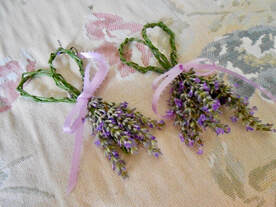
| You'll need 6 stalks of lavender Ribbon - I've been using 3/16 inch light pink or lavender satin ribbon for all my projects. It's not too large to over power the lightness of the flowers. Make two lavender braids using 3 stalks for each braid. When they are braided, bend each one into a loop. Put the two loops together to form a heart, keeping the flowers on top. Cut off the stems in the back and tie with a ribbon. |
Candied Lavender Garnishes
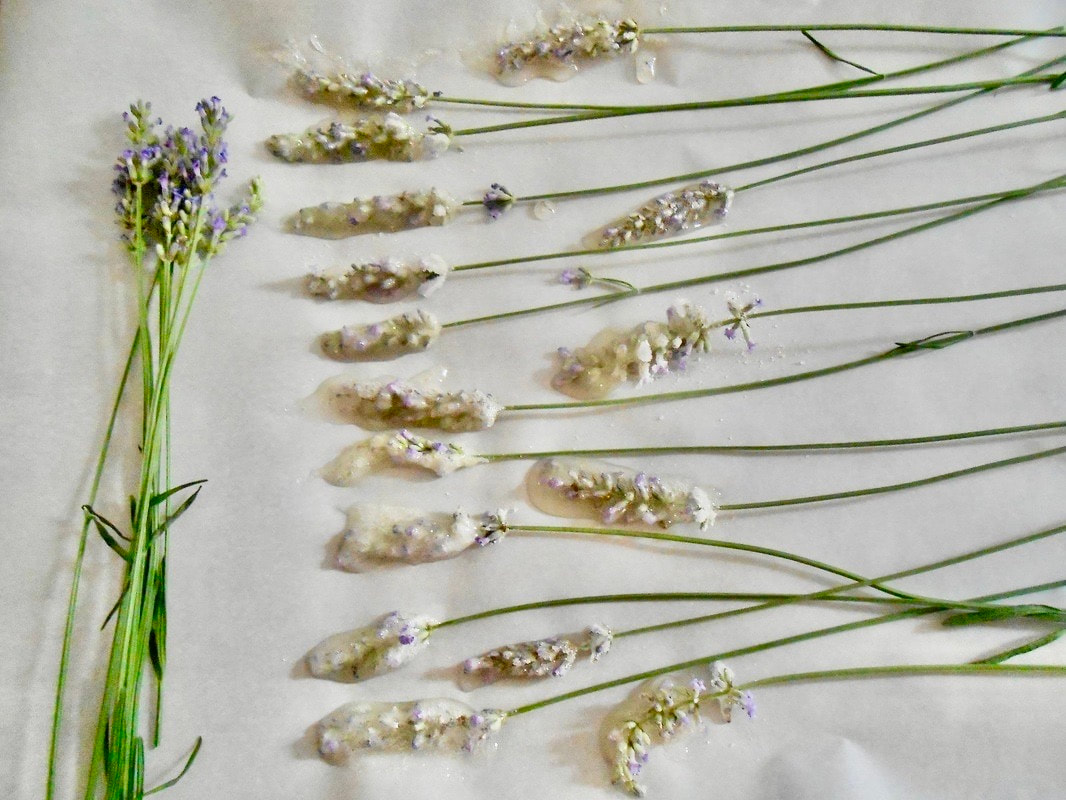
| 12 to 18 stalks of lavender One egg white, beaten until frothy 1/3 cup of granulated sugar Waxed paper or parchment paper Dip just the flowers of the lavender into the egg whites to completely cover, then dip them into the sugar. Place on waxed paper or parchment paper and let dry away from heat or sun. Use as a garnish with fruit salad, lemonade, or iced tea. |
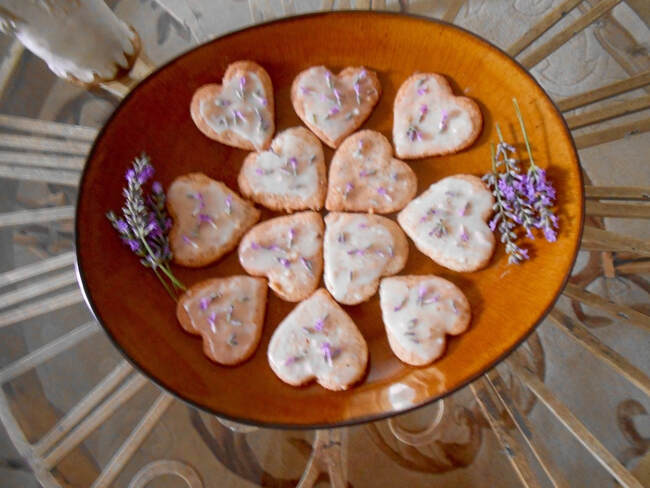
Almond Lavender Cookies
1/2 cup sugar
2 Tablespoons fresh lavender blossoms
I cup (two sticks) butter at room temperature
2 cups almond flour
1 cup flour
Combine the sugar and fresh lavender blossoms using a food processor.
Add the butter and combine. Next add the flours.
Mix until thoroughly combined.
The batter will be soft.
Chill for 30 minutes.
Flour both sides of the dough and place between two long sheets of waxed paper.
Using a rolling pin, roll to 1/4 inch thickness. Work quickly. The dough will get soft again as you work with it.
Cut cookies with a cookie cutter dipped in flour.
Remove all the excess dough and return to the 'fridge.
This will make it easier to move your shaped cookies.
Gently lift cookies onto a cookie sheet lined with baking parchment paper.
Chill the cookies on the baking sheets for 30 minutes
Set oven temperature to 300 degrees F.
Once the oven is preheated, bake for about 30 minutes. Begin checking at 15 minutes and don't let the edges of the cookies brown.
Cool on a wire rack placed.
Glaze
1/2 cup confectioners sugar
1 Tablespoon water.
Mix thoroughly with a fork. Add a little more water if needed.
Keeping the cookies on the wire rack, move them over the sink if your rack fits, or place waxed paper underneath for easy clean up. This can get messy!
Use a spoon to lightly glaze the cookies. Top with lavender blossoms. Let the glaze set up and serve.
2 Tablespoons fresh lavender blossoms
I cup (two sticks) butter at room temperature
2 cups almond flour
1 cup flour
Combine the sugar and fresh lavender blossoms using a food processor.
Add the butter and combine. Next add the flours.
Mix until thoroughly combined.
The batter will be soft.
Chill for 30 minutes.
Flour both sides of the dough and place between two long sheets of waxed paper.
Using a rolling pin, roll to 1/4 inch thickness. Work quickly. The dough will get soft again as you work with it.
Cut cookies with a cookie cutter dipped in flour.
Remove all the excess dough and return to the 'fridge.
This will make it easier to move your shaped cookies.
Gently lift cookies onto a cookie sheet lined with baking parchment paper.
Chill the cookies on the baking sheets for 30 minutes
Set oven temperature to 300 degrees F.
Once the oven is preheated, bake for about 30 minutes. Begin checking at 15 minutes and don't let the edges of the cookies brown.
Cool on a wire rack placed.
Glaze
1/2 cup confectioners sugar
1 Tablespoon water.
Mix thoroughly with a fork. Add a little more water if needed.
Keeping the cookies on the wire rack, move them over the sink if your rack fits, or place waxed paper underneath for easy clean up. This can get messy!
Use a spoon to lightly glaze the cookies. Top with lavender blossoms. Let the glaze set up and serve.
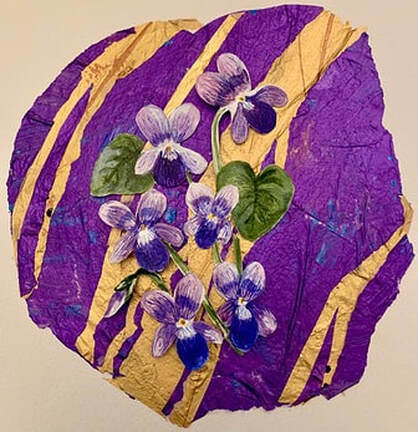
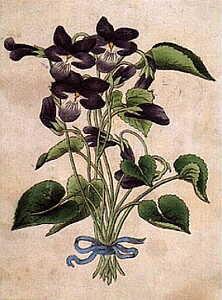
Viola spp.
Gender: Feminine
Element: Water
Planet: Venus
Gender: Feminine
Element: Water
Planet: Venus
Violets delight me! They visit for such a short time in the spring, yet have numerous attributes and an extensive history. Violets will protect you from “wykked sperytis” and will bring luck and love. They are featured in mythology, folk lore, literature and poetry. They have been used to cure headaches, calm tempers, and induce sleep. They have been crystallized, used for syrups and jellies, and candied.
There are over 550 species of violets, found in temperate climates around the world. They have many folk names and most of them are reminiscent of sex or love, as they are associated with the planet, and goddess of love, Venus. In addition, their leaves are often heart shaped, giving them a place of honor with the romancing herbs.
Like the rose, the color of the violet has great significance in sending messages. Blue violets promise "My love will always be true", and purple send the message, "I return your love." White signifies "I'm willing to take a chance on happiness". In William Cullen Bryant’s poem "The Yellow Violet", he associated the yellow violet with a lost love. In the language of flowers, yellow symbolizes friendship, happiness, joy and success. All violets represents modesty and humility, as they often hide their spectacular beauty under their leaves.
Violets are highlighted in many myths and legends. One rather disturbing story comes from the goddess Venus asking her son Cupid if he thought she was more attractive than a group of maidens playing along the edge of the woods. He said he found the maidens to be more beautiful, so she beat them until they were blue. I doubt that it’s valid. She is the goddess of love, after all!
Another legend states at one time violets were white, but Mary's grief at seeing the suffering of Jesus on the cross turned them all blue. They have been associated with the modesty of the Virgin Mary, the Angel Gabriel, the Holy Trinity, and Greek and Roman legends and lore. Athens has been referred to as the "Violet Crowned City”. They have also been associated with Napoleon.
There are over 550 species of violets, found in temperate climates around the world. They have many folk names and most of them are reminiscent of sex or love, as they are associated with the planet, and goddess of love, Venus. In addition, their leaves are often heart shaped, giving them a place of honor with the romancing herbs.
Like the rose, the color of the violet has great significance in sending messages. Blue violets promise "My love will always be true", and purple send the message, "I return your love." White signifies "I'm willing to take a chance on happiness". In William Cullen Bryant’s poem "The Yellow Violet", he associated the yellow violet with a lost love. In the language of flowers, yellow symbolizes friendship, happiness, joy and success. All violets represents modesty and humility, as they often hide their spectacular beauty under their leaves.
Violets are highlighted in many myths and legends. One rather disturbing story comes from the goddess Venus asking her son Cupid if he thought she was more attractive than a group of maidens playing along the edge of the woods. He said he found the maidens to be more beautiful, so she beat them until they were blue. I doubt that it’s valid. She is the goddess of love, after all!
Another legend states at one time violets were white, but Mary's grief at seeing the suffering of Jesus on the cross turned them all blue. They have been associated with the modesty of the Virgin Mary, the Angel Gabriel, the Holy Trinity, and Greek and Roman legends and lore. Athens has been referred to as the "Violet Crowned City”. They have also been associated with Napoleon.
Corporal Violet (Napoleon Bonaparte) used Violets to
Announce His Plan to Return from Exile
Napoleon chose the violet as his emblem, announcing that in spite of his exile in Elba in 1814, like the violet, he would return in the spring. The violet postcards were sent to his loyal supporters to reassure them. He returned, as promised, but his victory was short-lived.
Can you find the three faces in the postcard? The profiles of Napoleon, Marie Louise, and their three year old son Charles, are hidden among the violets.
Spring Salad with Violets
My favorite use for violets is sprinkled on a tossed green salad (you could use spinach, red lettuce, kale, romaine, or any combination) when she first appears in the spring. She is rich in vitamins A and C, as well as antioxidants. Add raspberries or strawberries, orange sections, radishes, red onions and avocado. Use your favorite vinaigrette salad dressing or try my Raspberry Poppy Seed Dressing from an earlier newsletter!
My grandmother grew tulips in many colors of the rainbow next to her wrap around porch on her farm in Greencastle, Indiana. She passed years ago, but this poem by Lisa Schroeder reminds me of her.
Tulipa spp.
Gender: Feminine
Element: Earth
Planet: Venus
As a child, tulips reminded me of my grandmother and the promise of spring! The varieties are delightful from the huge Emperor tulips, classic Dutch, double tulips, fringed, flared, parrot and more. All colors from pristine white to deep black, and every color in between are available, with some having two or more colors! Tulips planted around a home were thought to provide protection from curses and evil spirits, and bring prosperity and luck.
They originated in Central Asia and Turkey, and were associated turbans and protection. I always thought they came from the Netherlands, but they didn’t arrive there until the 17th century, and were a symbol of wealth and status. There was a period during 1636 and 1637, called the Dutch Golden Age, when the prices for exotic and rare tulip varieties skyrocketed. One of the most expensive bulbs was compared to the price of a brownstone home in New York City. The ‘mania’ was short lived and the collapse of the bubble had economic repercussions long after the brief period of madness.
Many of you know I research topics for my workshops and topics using the alphabet. When I got to H as I was researching tulips, I was surprised to learn of the Hunger Winter. Tulips were used as food in attempts to stay alive, but tens of thousands died, and many suffered long term health issues for the rest of their lives. Actress Audrey Hepburn was a teenager living in the Netherlands during the winder of 1944 - 1945. She suffered from malnutrition and hardships as a result of the famine.
They originated in Central Asia and Turkey, and were associated turbans and protection. I always thought they came from the Netherlands, but they didn’t arrive there until the 17th century, and were a symbol of wealth and status. There was a period during 1636 and 1637, called the Dutch Golden Age, when the prices for exotic and rare tulip varieties skyrocketed. One of the most expensive bulbs was compared to the price of a brownstone home in New York City. The ‘mania’ was short lived and the collapse of the bubble had economic repercussions long after the brief period of madness.
Many of you know I research topics for my workshops and topics using the alphabet. When I got to H as I was researching tulips, I was surprised to learn of the Hunger Winter. Tulips were used as food in attempts to stay alive, but tens of thousands died, and many suffered long term health issues for the rest of their lives. Actress Audrey Hepburn was a teenager living in the Netherlands during the winder of 1944 - 1945. She suffered from malnutrition and hardships as a result of the famine.
Illustrated Journal Pages on the Hunger Winter
The deaths during the hunger winter resulted from a variety of factors. It was a harsh and brutal winter, and the Germans requisitioned food from the Netherlands to support their war efforts, depleting the food supply for the Dutch population. Allied forces implemented a blockade to German occupied territories, and bombings and military action in the area greatly impacted transporting food.
Sketches from my Illustrated Journal
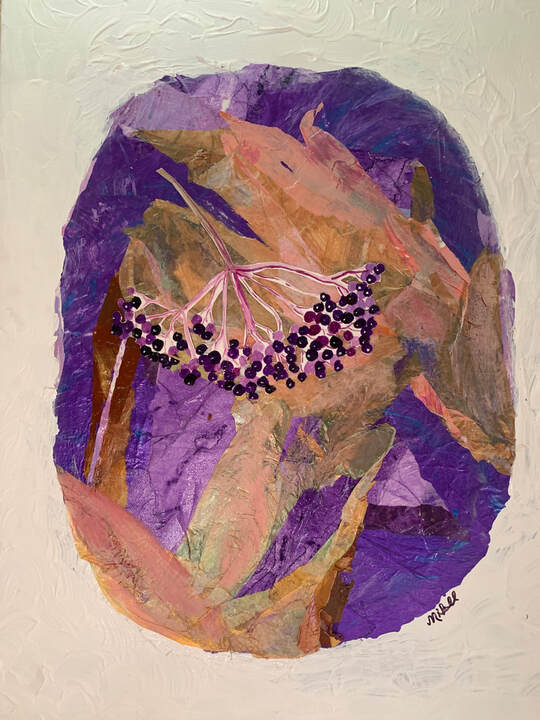
Sambucus canadensis
Gender: Feminine
Planet: Venus
Element: Water
Planet: Venus
Element: Water
My grandmother made fabulous jellies, jams, marmalades and preserves. She always had an assortment on the breakfast table, often with homemade, melt-in-your-mouth biscuits. She used a variety of fruits - grapes, apricots, apples, peaches, pears, strawberries, raspberries and there may be some I’m forgetting. My favorite by far was elderberry jelly. It’s still my favorite.
Elderberry is a powerful antioxidant. It boosts the immune system, is high in vitamin C, reduces inflammation, lowers stress, is good for heart health, as well as respiratory health. Many people, myself included, are convinced it lessons the chances of getting colds and the flu. And I think it’s beautiful!
One of my most memorable experiences with the American Elder was with the flowers, not the berries. I was on a camping trip, and one of the cooks was making pancakes for breakfast. She gathered a few of the white-blossomed umbrels, dipped them in pancake batter, placed them in the cast iron skillet, and snipped the stems off. They looked like lace doilies and tasted delicious!
Elder has been around a long time and is associated with numerous legends. The seeds were reportedly used in Switzerland in 2,000 B.C., and both Hippocrates and Pliny the Elder praised its medicinal properties. Over the years, it has had a wide variety of folk names. It was called Pipe Tree since the hollow stems were used as whistles . At one time, it was rumored to be the tree Judas was hanged on. It was condemned as the wood of the cross of Calvary and began to be analogous with darkness, sorrow and death. It was called the Tree of Doom and the Devil’s Eye.
Fear and superstition surrounded the elder. Trimming the branches or using the wood for firewood was certain to bring bad luck. If furniture was made from the wood, the bad luck was carried into the owner’s homes. Magicians, however, often took the risk to cut off a branch and use it for their magic wands.
Another folk name, Lady Ellhorn, was associated with the belief that a witch lived in each bush, further substantiated by the red sap that bled when the tree was cut. To ensure safety before cutting down an elder plant, it was recommended that these words be used for protection:
Elderberry is a powerful antioxidant. It boosts the immune system, is high in vitamin C, reduces inflammation, lowers stress, is good for heart health, as well as respiratory health. Many people, myself included, are convinced it lessons the chances of getting colds and the flu. And I think it’s beautiful!
One of my most memorable experiences with the American Elder was with the flowers, not the berries. I was on a camping trip, and one of the cooks was making pancakes for breakfast. She gathered a few of the white-blossomed umbrels, dipped them in pancake batter, placed them in the cast iron skillet, and snipped the stems off. They looked like lace doilies and tasted delicious!
Elder has been around a long time and is associated with numerous legends. The seeds were reportedly used in Switzerland in 2,000 B.C., and both Hippocrates and Pliny the Elder praised its medicinal properties. Over the years, it has had a wide variety of folk names. It was called Pipe Tree since the hollow stems were used as whistles . At one time, it was rumored to be the tree Judas was hanged on. It was condemned as the wood of the cross of Calvary and began to be analogous with darkness, sorrow and death. It was called the Tree of Doom and the Devil’s Eye.
Fear and superstition surrounded the elder. Trimming the branches or using the wood for firewood was certain to bring bad luck. If furniture was made from the wood, the bad luck was carried into the owner’s homes. Magicians, however, often took the risk to cut off a branch and use it for their magic wands.
Another folk name, Lady Ellhorn, was associated with the belief that a witch lived in each bush, further substantiated by the red sap that bled when the tree was cut. To ensure safety before cutting down an elder plant, it was recommended that these words be used for protection:
Lady Ellhorn, give me they wood,
And I will give thee of mine,
When I become a tree.
And I will give thee of mine,
When I become a tree.
Saying these words before making the first cut gave the witch an opportunity to leave the tree without experiencing any harm.
In spite of the fears associated with using the plant, the elder is praised for its ability to protect. If an elder is planted on a property, it will protect the family from lightning, negativity, snakes and evil spirits. Robbers will be unable to enter the home, and the occupants will be guaranteed prosperity. Placing elderberries under the pillow is said to ensure a good night’s sleep, as long as you aren’t the one who has to do the laundry the next day.
When I was in middle school, I read that some plants are good for the eye, others are good for the soul. Elderberries are good for the eye, the soul and the body. If you aren’t familiar with this delightful plant, I suggested you take a proactive approach to meet it personally! A plant that contributes to good health and prosperity, and will protect you and your home is one to be treasured!
Welcome to my Blog!
Do you love celebrating nature, botanical art, herbal recipes, crafts, legend and lore? I’d love to hear about your favorites. I’m inspired by words, the alphabet, and things that begin with the letter v- variety, vases, vulnerability, violets, vintage, vacations, vanilla, and velvet. Do you have a favorite letter of the alphabet? What is it, and why do you love it?
Categories
All
Botanical Illustrations
Celbrations
Herbal Crafts
Herbal History
Herbal Lore
Herbal Recipes
Lessons
Quotes
Symbolism
RSS Feed