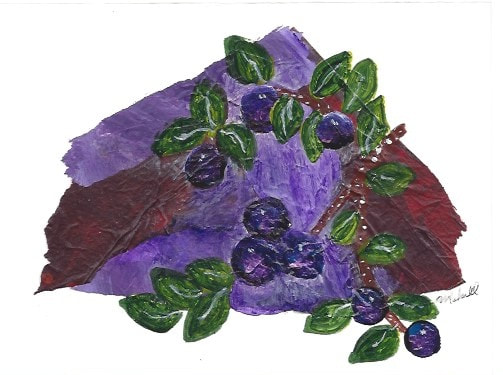
Box Huckleberry Element: Water Gender: Feminine Planet - Venus Can you name a plant that covers 8 acres of land, is 1300 years old, will protect you and bring you luck as you enter the new year? The box huckleberry is a member of the Ericaceae family, which includes azaleas, rhododendron, trailing arbutus, cranberries and blueberries and more. This particular plant is enormous, but in an understated way. Unlike the giant Sequoias and the Bristlecone pines, known for their size and their age, the box huckleberry is only about a half a foot tall. It covers the forest floor and can easily be overlooked.
My youngest daughter and I have always loved hiking and discovering natural treasures. One of our favorite jaunts is to visit the Hoverter and Sholl Box Huckleberry in Perry County, Pennsylvania. There are two box huckleberry plants in the area. One, at Losh Run, is thought to be over 13,000 years old! Bristlecone pines, at 5,000 years old, were considered to be the oldest living organisms on earth, yet the box elder is significantly older. The age is determined by the rate of growth, approximately 6 inches a year, and was calculated by the size of the plants. Unfortunately, part of the Losh Run Box Huckleberry, which at one time covered an area of about 100 acres, nearly 10 times larger than the Hoveter Sholl, was partially destroyed during the 1970s due to road construction of U.S. 22/322. The remainder is in an area difficult to access. The younger plant is estimated to be 1,200 to 1,300 years old, and fortunately is in a protected area as a National Natural Landmark. The 8 acre colony is situated on a 10 acres area in Tuscarora State Forest with a quarter mile path around the plant. Twenty-seven stations along the loop give information about the the plant. The Hoveter Sholl plant was discovered in 1845 by Spencer Fullerton Baird, professor at Dickinson College in Carlisle. He was a naturalist and became the first curator of the Smithsonian Institution and later the second Secretary of the institution. The box huckleberry was almost forgotten until 1948 when Dr. Fredrick Coville, a graduate of Cornell University working for the Department of Agriculture, determined the extensive growth, covering over 8 acres, was one massive plant! Have you discovered natural wonders worth sharing with others? Have you had any unexpected finds while taking hikes and exploring less traveled paths? Please share them in the comments below!
0 Comments
Leave a Reply. |
Welcome to my Blog!Do you love celebrating nature, botanical art, herbal recipes, crafts, legend and lore? I’d love to hear about your favorites. I’m inspired by words, the alphabet, and things that begin with the letter v- variety, vases, vulnerability, violets, vintage, vacations, vanilla, and velvet. Do you have a favorite letter of the alphabet? What is it, and why do you love it? Categories
All
|
RSS Feed