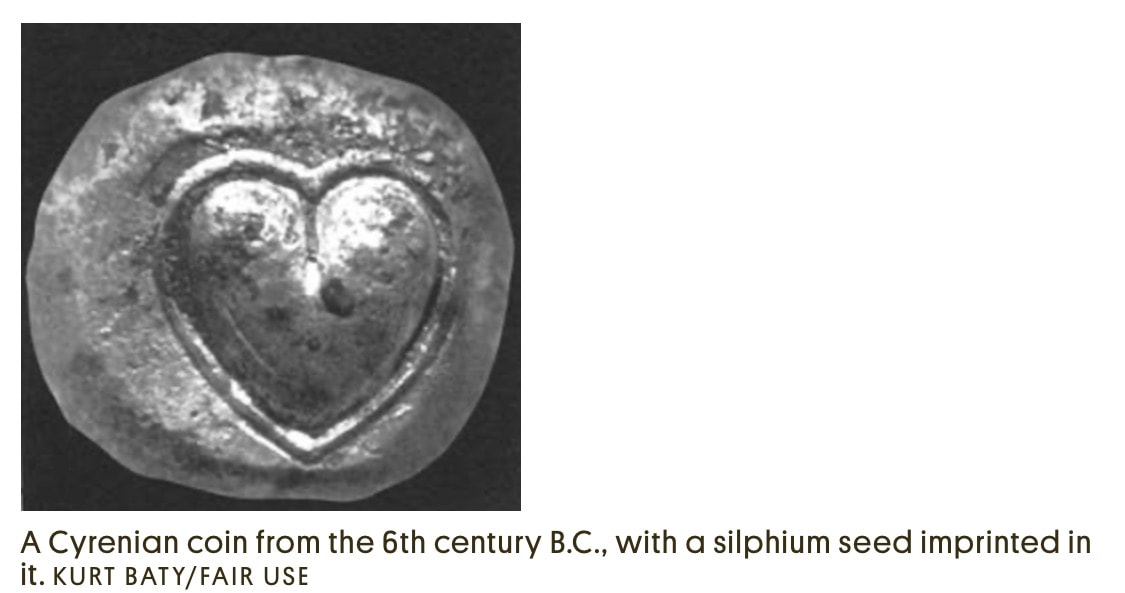
The Silphium Seed and More Valentine's Day, celebrated annually on February 14th, is a day dedicated to expressing love and affection to those dear to us. Central to this celebration is the iconic symbol of love – the heart. I’ve always assumed that the heart shape associated with Valentine’s Day came from the shape of the human heart. According to ancient origins, the first association of the heart symbol came from a plant grown in North Africa that became extinct before 1753 when the Linnaeus system for botanical nomenclature first began. The plant, silphium, is said to have looked like a giant fennel, with yellow flowers and leaves similar to celery. It only grew in a limited area, a plot one hundred miles long and twenty-five miles wide, that is now known as eastern Libya. It was in such high demand that its value was compared to silver and gold. The plant was widely used in Ancient Greek and Roman societies as a seasoning and medicine, but was also associated with romance and sex. It was used to make perfume, said to be an aphrodisiac, and was also valued as a form of birth control. The silphium seed pod was the shape of a heart. During the Middle Ages, the heart shape gained prominence in European art and culture. However, the heart symbol as we know it today started to take form during the medieval period. The concept of courtly love, popularized in literature and poetry, depicted love as an ennobling force. Artists began incorporating the heart shape into their work as a visual representation of love and passion. As Christianity spread throughout Europe, the heart shape took on new meanings. The sacred heart, symbolizing the love of Christ, became a prominent motif in Christian art. The heart was often depicted surrounded by flames, symbolizing divine love and purity. This religious association with love likely contributed to the enduring connection between the heart shape and romantic love. The Renaissance era further solidified the heart shape's association with love and romance. Artists like Leonardo da Vinci and Albrecht Dürer incorporated the heart symbol into their works, contributing to its widespread recognition. The heart shape became a common motif in paintings, tapestries, and sculptures, representing the emotional and passionate aspects of human relationships. In the 19th century, the commercialization of Valentine's Day began in earnest. Greeting cards adorned with romantic imagery, including the heart shape, became popular tokens of affection. The heart symbol was increasingly associated with expressions of love, and its presence on Valentine's Day cards became almost ubiquitous. In the 20th century, the heart symbol's association with love reached new heights. It became a universal and easily recognizable emblem of affection. The heart shape featured prominently in advertising, fashion, and popular culture, solidifying its status as the quintessential symbol of love. My favorite association, and the one most surprising, was the heart-shaped seed pod of the now extinct silphium. Art, history, physiology, literature, poetry, religion and plants, in addition to romantic love, can all be celebrated on Valentine’s Day. There is something for everyone! I hope you will all find something of value to celebrate on this day.
0 Comments
Leave a Reply. |
Welcome to my Blog!Do you love celebrating nature, botanical art, herbal recipes, crafts, legend and lore? I’d love to hear about your favorites. I’m inspired by words, the alphabet, and things that begin with the letter v- variety, vases, vulnerability, violets, vintage, vacations, vanilla, and velvet. Do you have a favorite letter of the alphabet? What is it, and why do you love it? Categories
All
|

RSS Feed